
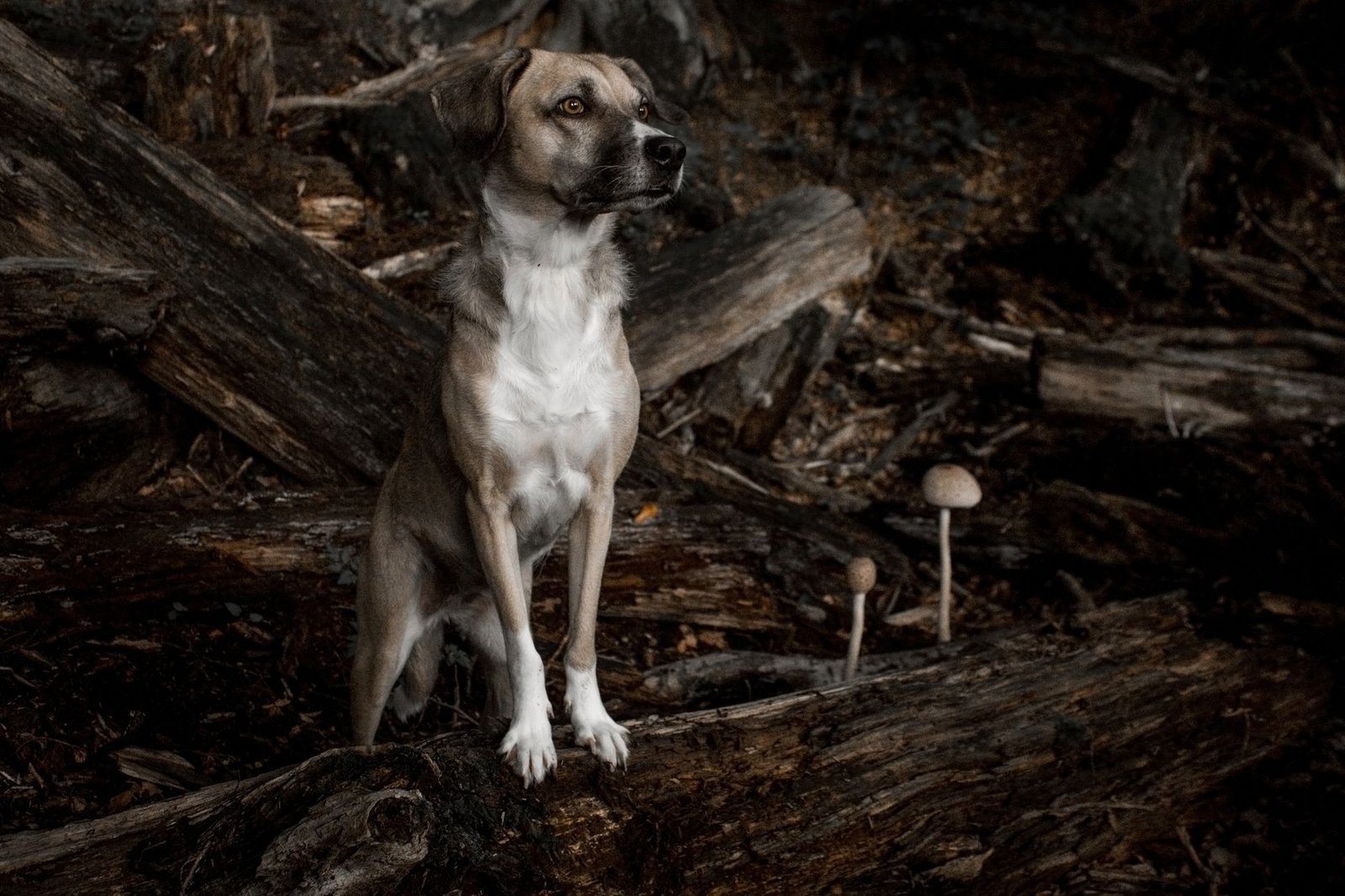
Once the rain settles in, mushrooms appear overnight on Kitsilano lawns, boulevards and park edges. Nobody can reliably identify them by sight, including us, so the rule is simple: if your dog has eaten a mushroom, photograph it, bag a second one, and phone us straight away rather than waiting to see what happens.
Why they all arrive at once
Fungi spend most of the year as threads through the soil and only fruit when conditions are right. In Vancouver that means the first sustained rain after a dry stretch, with the ground still holding some warmth, which is reliably late September through November.
So a boulevard that had nothing on it in August has two dozen mushrooms on it by the middle of October, and your dog walks the same route every day and notices immediately. They come up in lawns, in wood chip beds, at the base of street trees, along the edges of the park, under hedges and in the grass strips by the beach.
The Vancouver detail worth knowing: the death cap, which is the most dangerous mushroom in the world, is established in this city. It arrived on the roots of imported ornamental street trees, particularly hornbeam, beech and oak, and it fruits in exactly these weeks, in exactly the kind of boulevard planting that lines the streets around Kitsilano. It is not common. It does not need to be.
Nobody can identify them from a photograph, and that is the point
This is the single most useful thing in this article. Mushroom identification depends on features an owner standing in the rain cannot assess: whether there is a sac at the base of the stem under the soil, the colour of the spores, the gill attachment, the smell, the habitat and the tree it is growing with. Several deadly species look almost exactly like several harmless ones.
Which means there is no version of this where you look at your lawn, decide the mushroom is fine, and go back inside with confidence. There is only the version where you assume it might matter and make a phone call that takes two minutes.
Owners sometimes hesitate because they feel they should know what it was first. You do not need to know. That is our problem to work on, and the information we need from you is simpler than a name.
The four kinds of trouble
Broadly, mushrooms cause five different pictures, and the timing is the clue that matters most.
Liver injury, with a false recovery in the middle. This is the death cap group and it is the one that kills dogs. Six to twelve hours after eating, severe vomiting and diarrhea. Then, over the following day, apparent improvement, which is when owners stand down. Underneath, the liver is being damaged, and by two or three days in the situation is grave. That middle stage is the entire reason we ask you not to wait and watch.
Rapid nervous signs. Within fifteen minutes to twelve hours: drooling, watering eyes, urination, vomiting, a slow heart rate, or at the other extreme tremors, twitching and seizures. Fast onset is frightening but at least it is honest about itself.
Disorientation and odd behaviour. The hallucinogenic group, which grows readily in lawns and wood chips here. Dogs become wobbly, glassy-eyed, unusually vocal, sometimes anxious or over-reactive, and may have a raised temperature and tremors. Most recover with support, but a very agitated dog needs help settling and monitoring.
Kidney injury, slower still. Stomach upset early, then a quiet stretch of up to two days, then a dog who is drinking and urinating far more than usual, off food and flat, anywhere from two days to a week after eating. One of the species responsible for this grows here in the Pacific Northwest, and it is the reason the watch window runs to a week rather than to three days.
Plain stomach upset. The commonest outcome by a distance, and the reason most owners who have been through this once are relaxed about it the second time. Vomiting and diarrhea within a few hours, usually over in a day.
The difficulty is that the first several hours of the deadly group and the harmless group can look identical, and sometimes the harmless-looking hours are the deadly ones.
If your dog has already eaten one
If your dog is already wobbly, tremoring, seizing or collapsing, skip to the end of this list: get in the car now and collect the sample later, or ask someone else to grab one while you drive.
- Phone us now if we are open, 9:00 AM to 8:00 PM, and the nearest open emergency hospital if we are not. Either way, do not spend an hour watching. With mushrooms, the window where help is most straightforward is early, and the species that matters most has a deceptive middle phase.
- Photograph what is left, from the side, from above, and from underneath if you can tip one over. The underside and the base matter more than the cap.
- Pick a second one and bag it. Wrap it in paper or foil rather than plastic, which turns it to mush, and keep it cool. A physical sample is worth far more than a description.
- Note where it was growing. In grass, in wood chips, on a stump, or at the base of a particular tree. The tree association is a genuine clue.
- Note the time and roughly how much.
- No home attempt at bringing it back up. Not with salt, not with peroxide, not with anything.
- Give nothing from your own cabinet.
- Come in, and bring the sample.
Bring them to our urgent care, where our pet diagnostics team can check liver values and clotting, and with the liver-injury group a repeat sample over the following days tells us far more than the first one, because early results can look reassuring while damage is still developing. Our medical services team handles that follow-up.
We are open every day from 9:00 AM to 8:00 PM, and 9:00 AM to 5:00 PM on statutory holidays. Mushrooms get eaten on the morning walk and on the last walk of the night, and both of those can fall outside our hours, so if it falls outside those hours, make for whichever emergency hospital is open and let them know you are coming. A mushroom is never worth holding until morning.
The dog who keeps doing it
Some dogs eat mushrooms once and never again. Others work every lawn like a buffet, and for those households the problem is not a single incident but a whole season of them.
- Walk the yard before you let them out, every day in the wet months. Mushrooms appear overnight, so yesterday’s check does not count.
- Pick and bag rather than kick. Kicking a mushroom over leaves the pieces at nose height in the grass. Pick them, bag them, put them in the garbage, and wash your hands.
- Deal with the source if you can. Mushrooms fruiting in one spot year after year usually mean buried wood, an old stump or a rotting root below. Removing that is the only real fix.
- Keep the leash short past boulevard trees and wood chip beds, which is where the ones we worry about most turn up.
- Teach a reliable leave it and a trade, and carry something good enough to make trading worthwhile.
- Consider a basket muzzle for walks if your dog is a committed scavenger, introduced gradually over a couple of weeks so your dog is happy to put its nose in before the strap is ever done up. A well-fitted basket muzzle lets a dog pant, drink and sniff freely. Choose one with narrow gaps, because a determined dog can still get a small mushroom through a wide basket, keep it on only while you are there, and rely on it as one layer rather than the whole answer.
- Rake and clear wet leaf litter, which both hides mushrooms and helps them along.
Our guide on spring plants that can harm your cat covers the other half of the year, and a wellness program visit is a good moment to talk through a dog who eats everything, because sometimes that habit has a reason behind it.
Cats, and the smaller picture
Cats very rarely eat mushrooms. They are more selective about what they put in their mouths and less interested in things growing out of grass. The exceptions are kittens, indoor cats who get at a mushroom that has come up in a houseplant pot, and the occasional cat who chews anything.
The signs to act on are the same, and so is the advice: photograph it, bag one, phone us.
Frequently asked questions
My dog ate a mushroom from the lawn but seems completely fine. Do I need to do anything?
Phone us today, and bag a second mushroom from the same spot. Seeming fine in the first hour tells us very little, and the species that causes the most harm has a stage where the dog appears to improve before the serious damage shows itself. A call now is two minutes; a call on day three is a different conversation.
How do I know if it was a dangerous one?
You cannot tell by looking, and neither can we from a photograph alone. That is why we ask for a physical sample and for where it was growing. Identification depends on the base of the stem, the spores and the tree it was associated with, none of which survive a guess.
Are the mushrooms in my lawn the dangerous kind?
Most lawn mushrooms in Vancouver are harmless or cause a passing stomach upset. Lawn and wood-chip mushrooms include small brown ones carrying the same liver toxin as the death cap, and at least one of those has killed a dog in North America. Street-tree mushrooms get the most attention because the death cap grows with imported ornamentals, but open turf and mulch are not a safe category, which is why the answer to any individual mushroom is still to bag it and call.
Should I make my dog sick to get it up?
No. Please do not use salt, peroxide or anything else at home. Whether bringing it back up is the right move depends on what was eaten and how long ago, it needs to be done where your dog can be monitored, and it becomes unsafe once an animal is wobbly or tremoring.
My dog ate mushrooms last autumn and was fine. Does that change anything?
Only in that it may have made you more relaxed, which is the risk. Last year’s mushroom and this year’s may be completely different species on the same lawn. Each incident needs its own phone call.
Can I use a store-bought mushroom test or an app to identify it?
We would not rely on one for a decision about your dog. Identification apps are improving and still get dangerous species wrong, and the features that separate a deadly mushroom from a harmless lookalike are often underground or microscopic. Use the app if you like, and call us regardless.
How long should I watch my dog afterwards?
We will give you a window based on what was eaten, and in general the first week matters rather than the first few hours. Vomiting, diarrhea, wobbliness, tremors, yellowing of the gums or eyes, drinking or urinating much more than usual, going off food days later, or a dog who perked up and then went flat again, all mean come straight back.
Speak to the team at Cypress St. Animal Hospital
If your dog has eaten a mushroom, phone us, bag a second one from the same spot, and bring it in. If it happens outside our hours, go to the nearest open emergency hospital and call them on the way.
Published by the team at Cypress St. Animal Hospital.
This article is for general educational purposes only and is not a substitute for an in-person veterinary examination or advice about your individual pet. If you have an urgent concern about your pet, contact Cypress St. Animal Hospital or your nearest emergency veterinary hospital right away.
Cypress St. Animal Hospital
1889 Cornwall Ave, Vancouver, BC V6J 1C6
Phone: (604) 734-2500
Email: cypresshospital@gmail.com
Hours: Every day 9:00 AM to 8:00 PM; statutory holidays 9:00 AM to 5:00 PM